Loading page…


Annapurna, Nepal Best in Spring · Autumn
Annapurna Base Camp Trek
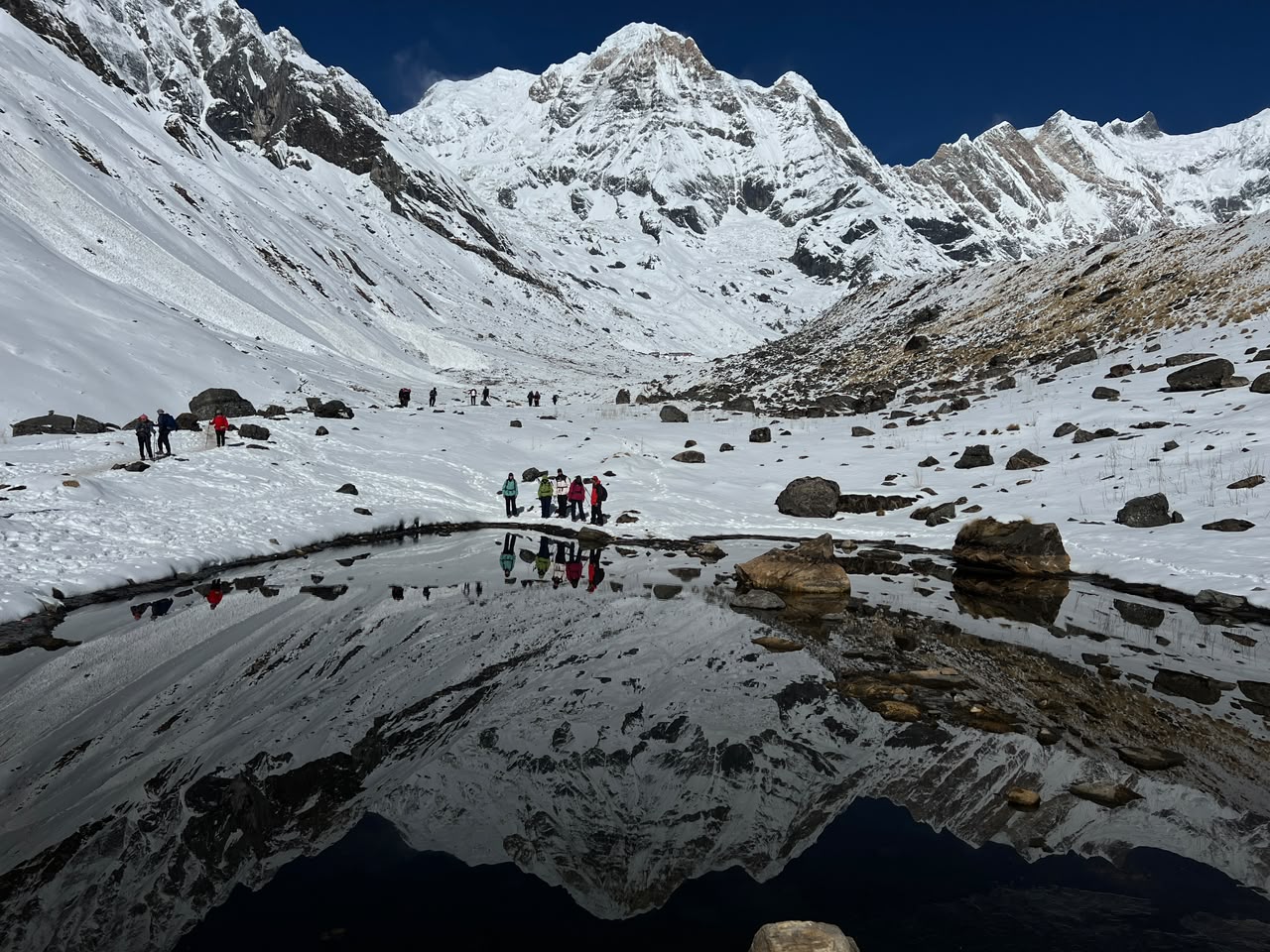
Journey into the heart of the Annapurna Sanctuary on this 9-day Annapurna Base Camp Trek. Walk through forests and mountain villages to reach ABC at 4,130 metres, surrounded by Annapurna I, Machhapuchhre and Hiunchuli.
Duration
9 days
Maximum altitude
4,130 m / 13,550 ft
Difficulty
Challenging
Guest rating
Not rated yet
From
$750
Why you'll love it
About the Annapurna Base Camp Trek
The Annapurna Base Camp Trek is a 9-day Himalayan journey into the heart of the Annapurna Sanctuary in Nepal. The trek reaches Annapurna Base Camp at 4,130 metres, where a natural amphitheatre of high mountains surrounds the trail.
The journey begins in Kathmandu before traveling by road to Pokhara, the gateway to the Annapurna Region. From Pokhara, a mountain road leads to Jhinu Danda, where the walking route begins.
The trail climbs through Sinuwa, Bamboo, Dovan and Deurali before entering the high-altitude sanctuary. Trekkers pass Machhapuchhre Base Camp on the way to Annapurna Base Camp, where close views of Annapurna I, Annapurna South, Machhapuchhre, Hiunchuli and surrounding peaks dominate the landscape.
After spending the night at base camp, the route descends through Bamboo and Jhinu Danda. Ground transportation then returns trekkers to Pokhara and Kathmandu.
This itinerary is suitable for active travelers looking for a compact but demanding Himalayan trek with diverse landscapes, teahouse accommodation and views of one of the world’s great mountain ranges.
Why Choose the Annapurna Base Camp Trek?
The Annapurna Base Camp Trek leads directly into a high Himalayan sanctuary surrounded by some of Nepal’s most recognizable mountains.
Unlike viewpoints where mountains are seen from a distance, Annapurna Base Camp places trekkers inside a glacial basin beneath Annapurna I, which rises to 8,091 metres and is the world’s tenth-highest mountain.
The route offers significant landscape diversity within a relatively short itinerary. Trekkers pass through cultivated hills, traditional settlements, bamboo forest, rhododendron woodland, river gorges, avalanche-shaped valleys and high alpine terrain.
The journey does not require a domestic flight. Kathmandu, Pokhara and the trailheads are connected by road, making the trek suitable for travelers who prefer overland transportation.
Annapurna Base Camp Trek Difficulty
The Annapurna Base Camp Trek is graded challenging. Most trekking days involve five to eight hours of walking on stone steps, forest paths and uneven mountain terrain.
The itinerary climbs from Jhinu Danda to Annapurna Base Camp within three trekking days. Trekkers should maintain a slow pace and closely monitor their response to increasing elevation.
No technical climbing experience is required. However, participants should have good cardiovascular fitness, leg strength and the ability to walk uphill and downhill on consecutive days.
Training should include regular walking, stair climbing, cardiovascular exercise and progressively longer day hikes for at least four to six weeks before departure.
Annapurna Base Camp
Annapurna Base Camp is situated at approximately 4,130 metres inside the Annapurna Sanctuary. It is the highest sleeping point and principal destination of this itinerary.
The base camp provides close views of Annapurna I, Annapurna South, Hiunchuli, Machhapuchhre and other peaks surrounding the glacial basin.
Sunrise and sunset can create changing colors across the mountain faces, although visibility depends on weather and seasonal conditions.
The base camp contains simple teahouses rather than permanent luxury accommodation. Facilities become limited because food, fuel and other supplies must be transported through the mountain valley.
Machhapuchhre Base Camp
Machhapuchhre Base Camp, commonly called MBC, lies at approximately 3,700 metres between Deurali and Annapurna Base Camp.
Although named a base camp, Machhapuchhre is considered sacred locally and is not open for commercial climbing. The settlement serves as an important rest point for trekkers entering the upper sanctuary.
From MBC, the trail continues gradually toward Annapurna Base Camp through open alpine terrain with increasingly wide mountain views.
Annapurna Sanctuary
The Annapurna Sanctuary is a high glacial basin enclosed by Himalayan peaks. The narrow entrance beyond Deurali opens into a broad mountain amphitheatre containing glaciers, moraine and alpine terrain.
The sanctuary’s geography creates a dramatic transition from the forested lower valley to a landscape dominated by snow, rock and ice.
Trekkers should respect local cultural and environmental practices throughout the sanctuary. Natural objects, prayer flags and religious structures should not be removed or disturbed.
Mountain Views
The trek offers views of Annapurna I, Annapurna South, Machhapuchhre, Hiunchuli, Gangapurna, Gandharba Chuli and other peaks in the Annapurna massif.
Annapurna I reaches 8,091 metres and is the tenth-highest mountain in the world. Machhapuchhre, also known as Fishtail Mountain, is recognized by its distinctive twin summit.
Mountain visibility depends on weather. Early mornings generally provide the clearest views, while clouds may develop later in the day.
Best Time for the Annapurna Base Camp Trek
The best seasons for the Annapurna Base Camp Trek are generally spring, from March to May, and autumn, from September to November.
Spring offers flowering rhododendron forests, warmer daytime temperatures and colorful vegetation along the lower trail.
Autumn usually provides clear skies, stable weather and excellent Himalayan visibility. October and November are among the busiest months, so advance booking is recommended.
Winter trekking may be possible with suitable equipment, but snow, ice and avalanche conditions can affect the trail above Deurali.
The summer monsoon brings heavy rain, clouds, leeches, slippery paths and possible landslides. Current weather and trail conditions should always be checked before departure.
Accommodation During the Trek
Hotel accommodation is provided in Kathmandu and Pokhara. During the trekking section, travelers stay in locally operated mountain teahouses.
Rooms usually contain two single beds, mattresses, blankets and pillows. Bathrooms may be private at lower elevations but are generally shared in the upper sanctuary.
Accommodation at Deurali and Annapurna Base Camp is limited. During busy seasons, rooms may be shared according to local lodge availability.
Hot showers, Wi-Fi, electricity and battery charging may be available for an additional fee. Availability and reliability decrease at higher elevations.
Meals and Drinking Water
Breakfast is provided at the hotels in Kathmandu and Pokhara. During the trekking section, breakfast, lunch and dinner are served in teahouses.
Common meals include dal bhat, soups, noodles, potatoes, pasta, fried rice, eggs, Tibetan bread and seasonal vegetables.
Menus become more limited and prices increase with elevation because supplies must be carried into the sanctuary.
Drinking water is available from teahouses and local sources. Trekkers should use properly boiled water, purification tablets or a reliable filtration system.
Carrying reusable water bottles helps reduce plastic waste inside the Annapurna Conservation Area.
Permits and Guided Trekking
The Annapurna Base Camp Trek enters the Annapurna Conservation Area. Trekkers require an Annapurna Conservation Area entry permit and applicable TIMS registration.
Himalera operates the route as a guided trek with a licensed trekking guide and arranges the included permits before departure.
Permit requirements and fees can change. The applicable regulations are confirmed when the trip is booked.
Altitude and Acclimatization
The itinerary reaches 4,130 metres at Annapurna Base Camp. Altitude sickness can affect any traveler regardless of fitness, age or previous experience.
The route gains elevation relatively quickly between Sinuwa, Deurali and Annapurna Base Camp. Trekkers should walk slowly, drink sufficient water and avoid alcohol during the ascent.
Symptoms such as persistent headache, nausea, dizziness, unusual fatigue, breathing difficulty or loss of coordination must be reported immediately.
The guide may stop the ascent or arrange a descent if a participant develops concerning symptoms.
Trail and Weather Safety
The section between Deurali and Machhapuchhre Base Camp passes through terrain affected by snow, ice, rockfall and avalanche conditions during certain periods.
The safest trail may change according to the season and current conditions. Trekkers must follow local signs and the guide’s instructions.
The guide may delay the departure, use an alternative trail, change the overnight location or turn the group around when conditions are unsafe.
Every traveler should have insurance covering trekking above 4,000 metres, emergency treatment, evacuation, trip interruption and cancellation.
Who Is the Annapurna Base Camp Trek For?
The Annapurna Base Camp Trek is suitable for active travelers who want to reach a Himalayan base camp within a compact Nepal itinerary.
It is particularly appropriate for trekkers interested in mountain scenery, forest trails, teahouse trekking and the landscapes of the Annapurna Sanctuary.
Previous high-altitude experience is helpful but not mandatory. Participants should prepare physically and be comfortable with long walking days, basic accommodation and changing mountain weather.
Trek highlights
Spend a night inside the spectacular Annapurna Sanctuary
See Annapurna I, the world’s tenth-highest mountain
Walk beneath Machhapuchhre, Annapurna South and Hiunchuli
Pass through Machhapuchhre Base Camp at approximately 3,700 metres
Trek through bamboo, oak and rhododendron forests
Experience sunrise and sunset surrounded by Himalayan peaks
Stay in locally operated mountain teahouses
Travel through Sinuwa, Deurali, Bamboo and Jhinu Danda
Experience dramatic changes from subtropical forest to glacial terrain
Complete the journey without taking a domestic flight
Explore the lakeside city of Pokhara
Enjoy a compact nine-day Himalayan base camp itinerary
Trek through the protected Annapurna Conservation Area
Descend through traditional settlements toward Jhinu Danda
Day by day
The itinerary
Arrive at Tribhuvan International Airport and meet a Himalera representative. Transfer to your hotel, complete check-in and attend a briefing about the Annapurna Base Camp Trek.
WalkingApproximately 30–45 minutes airport transferAltitude1,400 m / 4,593 ftMealsDinnerStayTeahouse lodge
- Airport welcome, Kathmandu arrival, hotel check-in, trek briefing
Pro tips
- Keep medication, travel documents and essential trekking equipment in your hand luggage in case checked baggage is delayed.
Transparent pricing
What's included
Included
- Airport arrival and departure transfers by private vehicle
- Two nights of twin-sharing hotel accommodation in Kathmandu with breakfast
- Two nights of twin-sharing hotel accommodation in Pokhara with breakfast
- Four nights of twin-sharing teahouse accommodation during the trek
- Tourist-bus transportation from Kathmandu to Pokhara
- Tourist-bus transportation from Pokhara to Kathmandu
- Ground transportation from Pokhara to Jhinu Danda
- Ground transportation from Jhinu Danda to Pokhara
- Three meals per day during the trekking section
- Licensed English-speaking trekking guide
- Assistant guide for groups of eight or more trekkers
- Porter service based on two trekkers sharing one porter
- Annapurna Conservation Area entry permit
- Agency-issued TIMS card
- Guide and porter wages, meals, accommodation and transportation
- Government taxes and official service charges
- Basic first-aid kit carried by the trekking guide
- Himalera duffel bag for use during the trek
- Trekking route map
- Annapurna Base Camp Trek completion certificate
Not included
- International airfare to and from Nepal
- Nepal entry visa fee
- Lunch and dinner while staying in Kathmandu
- Lunch and dinner while staying in Pokhara
- Travel, medical, evacuation and trip-cancellation insurance
- Personal trekking clothing and equipment
- Sleeping bag and down jacket unless separately arranged
- Hot showers, Wi-Fi, battery charging and electronic device use
- Bottled water, soft drinks, alcoholic beverages and additional snacks
- Personal expenses and optional activities
- Entrance fee for the Jhinu Danda hot spring
- Emergency evacuation or additional transportation
- Extra accommodation and meals caused by weather or itinerary changes
- Costs resulting from illness, injury, road delays or natural events
- Tips for trekking guides, porters and drivers
- Services not specifically listed under inclusions
Availability
Upcoming departures
ExpeditionDepartsDurationSpotsStatusBook
Annapurna Base Camp Trek24 Sep 20269 daysSold outFullSold out
Reserve your place
Ready for Annapurna Base Camp Trek?
Choose your trip style, departure, group size, and add-ons on the next step. We confirm availability before requesting payment.
20% deposit
$150
then $600 due 30 days before departure
Departure
Choose your date
Good to know
Frequently asked
The trek is challenging because it includes repeated climbs, long stone staircases and walking days of up to eight hours. The route reaches 4,130 metres at Annapurna Base Camp.
Plan your Annapurna Base Camp Trek
Practical background from our Nepal trekking guides to help you prepare for this route.
- Trekking in the Annapurna region Access, character and other routes in this region.
- Altitude and acclimatisation How to ascend safely and recognise altitude sickness.
- Best time to trek What each season means for this kind of route.
- Compare Nepal treks See how this route compares with Nepal's other classic treks.
More treks in Nepal
From
$750 · 9d